Opportunity Blog
Watch this page for conferences, jobs, fellowships, and internships in Art History and Museum & Cultural Heritage Studies.
Literary Gardens: Cultivation, Movement, and Modernism An International Online Conference | February 12–13, 2027
Abstract deadline November 6, 2026
Call for Papers and Digital Projects
Rutgers Art Review, a journal of graduate research in art history, hereby invites all current graduate students, as well as professionals who have completed their graduate degree within the past year, to submit papers and digital humanities projects for its 44th edition.
Papers may address all topics and historical periods within the history of art and architecture, visual and material culture, art theory and criticism, archaeology, cultural heritage and preservation, aesthetics, film, and photography. Interdisciplinary studies concerning art and architecture written by students in other fields are also welcome. To beconsidered for publication, submissions must present original contributions to existing scholarship and conform to our submission guidelines. We encourage authors to ask a faculty member to review their paper before submission.
We also invite authors to submit digital humanities projects for consideration. We seek submissions that address important art historical questions with the help of digital tools. Of particular interest are digital projects that use computational methods, mapping, networking, and/or 3D modeling to analyze and interpret art historical or archaeological materials. Authors of digital humanities projects must include an additional paragraph in their abstract detailing the functionality of their digital resource and its impact on their paper’s claims.
For more information, including submission guidelines, please visit: https://rar.rutgers.edu
In the body of the e-mail, please make sure to include:
Your name
Graduate program affiliation
Degree being pursued or previously completed within one year of submission
Mailing address
E-mail address
Please submit all required materials in a single PDF file by the deadline of November 6, 2026 to:
Gabrielle Ashby, Lindsey Hewitt, and Isla Stewart, Editors, Rutgers Art Review
rutgersartreview@gmail.com
Rutgers Art Review - The Graduate Journal of Research in Art History
Abstract deadline November 30, 2026
The Elizabeth von Arnim Society invites paper proposals for an international online conference on literary gardens, held in conversation with the Missouri Botanical Garden exhibit The Literary Garden: The Cultivation of Plants & Gardens in Narratives (Sachs Museum, May 2026–March 2027), curated by Nezka Pfeifer.
Inspired by the exhibition’s wide-ranging exploration of plants and gardens, this conference will consider gardens as spaces of literary cultivation, movement, and modernity. Gardens are never simply settings: they are imagined spaces, sites of labor and care, refuge and restoration, social and cultural exchange, but also places of exclusion, transgression, and imperialist pilfering. Plants, people, texts, ideas, and botanical knowledge move through them. Gardens can therefore illuminate modernism’s preoccupation with mobility, displacement, belonging, transformation, and the relationship between the human and more-than-human worlds.
The conference centers on modernism, broadly conceived, including fin-de-siècle precursors and modernism’s later extensions and legacies. We are particularly interested in women’s garden writing, including that of Elizabeth von Arnim, as well as the ways gardens participate in transnational literary and cultural networks. We welcome work on African American, Caribbean, diasporic, queer, Indigenous, and other perspectives that complicate and expand histories of modernism and the literary garden. We warmly encourage you to share this call with colleagues, graduate students, and independent scholars.
Keynote Speakers:
Nezka Pfiefer, curator of The Literary Garden: The Cultivation of Plants & Gardens in Narrativesat the Sachs Museum, Missouri Botanical Garden
Karina Jakubowicz, author of Gardens in the work of Virginia Woolf: Nature, Modernity, and the Politics of Space (2026 Edinburgh UP)
Subject areas: See conference details here
Submission Guidelines
Please submit an abstract of approximately 250 words for a 20-minute paper, or for a full panel (3-4 papers) 250 words per speaker. Include a short biographical note (100 words) for each speaker. Submit through our submission form: forms.gle/pqbJjueSge3pAFoL9 by November 30, 2026. Notifications of acceptance will be sent by mid-December 2026. The conference will be held online on February 12–13, 2027. Sessions will be scheduled with an international audience in mind; a detailed program, including access information, will follow upon acceptance.
Paid Internship at Goodwood Museum & Gardens
Apply Now!
- Organizing and rehousing garments according to collections care standards
- Researching and documenting provenance, condition, materials, and historical context for each piece, ultimately helping to determine the value of each item for the collection
- Photographing each item following professional collections photography standards
- Inputting all documentation and images into Goodwood’s collections database
- Training in collections database management, collections photography, accession and deaccessioning policy and procedures
- Instruction and training on giving museum tours
- Creating informative, inclusive, and engaging interpretive materials
- Mentorship from Goodwood’s collections/curatorial staff and committee members
- An opportunity to present findings to staff, volunteers, the public, and their peers (e.g., a short gallery talk and blog post highlighting discoveries from the collection on Goodwood’s website)
- Completion rate and quality of database records and textile storage organization (measured against a defined documentation standard rubric)
- Weekly meetings and formal mid-point and final evals between the intern and supervising staff
- An exit interview/reflection from the intern on their experience, skill growth, and program feedback
- Tracking the utility of the digital record and any public-facing materials used in future interpretation or exhibits
Call for Papers: Clark Art Insitute Graduate Symposium, April 9, 2027 (Williamstown, MA)
Abstract deadline November 20, 2026
“A Simultaneous Vision of the Page,” a day-long graduate symposium on April 9, 2027 at the Clark Art Institute in Williamstown, Massachusetts
“The ‘blanks’ indeed assume importance,” wrote French poet Stéphane Mallarmé about his 1897 poem Un coup de dés jamais n’abolira le hasard. “The paper intervenes each time an image, of its own accord, ceases or withdraws, accepting the succession of others.” More than seventy years later, Belgian artist Marcel Broodthaers turned to Mallarmé’s poem, reprising its title in his artist’s book, Un coup de dés jamais n’abolira le hasard. Image (1969). In it, Broodthaers obscured Mallarmé’s words with black bars while preserving their layout across the page. He printed these bars on translucent paper, bringing successive pages into view when stacked and bound—as if to fulfill, in his own way, Mallarmé’s call for “a simultaneous vision of the Page.”
This poem and artist’s book bracket one historical interval in which the page became a charged field of artistic and literary experimentation, collaboration, and exchange. The pairing of Mallarmé and Broodthaers represents only one history of the page, and current graduate students are encouraged to propose talks that bring others into view. Speakers are invited to explore how visual and literary practices were brought into relation on the surface, site, and space of the page between the 1890s and circa 1970. Interventions should probe how encounters between artworks and text on the page, a space long associated with literature, transformed the ways those works were seen, read, and written about. Of particular interest is how the page—even, and perhaps especially, its blank space—surfaced and structured social and political being.
Participants might consider, but need not limit themselves to, questions such as:
What role did typographic and design elements play in shaping hierarchies between text and image, and in negotiating authorial and artistic agency?
How did the materiality of the substrate—the texture and weight of the paper, for instance—complicate readings of unmarked space as neutral?
How did artistic movements leverage the mobility of the page to cultivate and expand transnational networks, as in the case of the Gutai Art Association?
In what ways did experiments on and between pages converge with, and diverge from, time-based media like film?
How did little magazines, such as those of the Harlem Renaissance, contend with the racial politics of the black-and-white page?
To what extent did experiments with transparency and superimposition destabilize the page as a discrete visual field?
Selected speakers will deliver 20-minute talks, followed by extended discussion, during this one-day semi-private symposium, held on Friday, April 9, 2027, at the Clark Art Institute in Williamstown, Massachusetts.
The event will conclude with a public keynote delivered by Trevor Stark (Associate Professor, Department of Art and Art History, University of Calgary, Canada).
The symposium is convened by Alana Frances Baer (Williams Graduate Program in the History of Art ’27) and the Research and Academic Program at the Clark Art Institute.
Current PhD, MFA, and MA students based in the United States in the fields of art history, studio art, and related disciplines such as comparative literature, English, and film and media studies are invited to submit an abstract of c. 200 words with CV to simultaneousvisionofthepage@gmail.com by November 20, 2026.
Notifications of acceptance will be sent in January. The Clark covers and arranges round-trip transportation to Williamstown, lodging, and hospitality during the convening.
For more details, visit: www.clarkart.edu/Research-Academic/RAP-Events/simultaneous-vision-of-the-page
Call for Papers: Inaugural FSU Inter-Humanities Symposium, April 1–2, 2027
Abstract deadline November 1
INAUGURAL INTER-HUMANITIES SYMPOSIUM AT FSU
“Borderless World: Text, Image, and Sound”
The Globe
Florida State University, Tallahassee
Confirmed Keynote Speaker:
Professor Martin Daughtry, Associate Professor of Music and Sound Studies, New York University
April 1-2, 2027
You may also visit us at IHS at FSU WordPress and find us on Instagram at interhumanities.fsu.
Call for Papers: University of Illinois Chicago’s 2027 Art History Graduate Student Symposium, March 6, 2027
Abstract deadline November 15
Art/Work
The History & Future of Art & Labor
This year’s 2026-2027 symposium is titled Art/Work: The History and Future of Art and Labor, and will take place in-person on March 6th, 2027 at the University of Illinois Chicago.
9-Month Fellowship, Washington & Lee University Art Museum
Apply Now!
UCLA Art History Graduate Symposium Call for Papers
Conference November 13; Abstracts due September 30
The UCLA Art History Graduate Student Symposium welcomes submissions for their annual conference (to be held Nov 13) from graduate students working across art history, visual studies, architecture, archaeology, museum studies, performance studies, and related fields. We encourag interdisciplinary, transhistorical, and global approaches.
Complete details: CALL FOR PAPERS
Please submit the following:
• A paper abstract of no more than 250 words
• A short curriculum vitae
• Submission deadline: September 30, 2026
• Notification of acceptance: October 13, 2026
• Symposium date: November 13, 2026
• Submission and inquiries: oguzcanunal@ucla.edu
FSU Inter-Humanities Graduate Symposium, "Borderless World: Test, Image, and Sound,” April 2027
Scholars, students, and artists are all encouraged and welcome to apply to our inter- and multidisciplinary symposium.

Openings at Fairfield County Museum in Winnsboro, SC
Fairfield County Museum in Winnsboro, SC has new full-time position openings for a director and a geneaology researcher,
DIRECTOR
- Salary: $45,000 – $55,000 (Depends on skills/experience) FULL-TIME
- Announcement Date: 06/03/2026
- MINIMUM EDUCATION AND EXPERIENCE REQUIREMENTS: Bachelor’s Degree in Applied History Education, Fine Arts, Public Administration or related discipline. Six (6) years of museum, library or related experience or an equivalent combination of education, training, and experience.
GENEAOLOGY RESEARCHER
- Salary: $34,500.00 Full Time
- Announcement Date: 07/28/2026
- MINIMUM EDUCATION AND EXPERIENCE REQUIREMENTS: Bachelor’s Degree in Applied History Education, Fine Arts, Public Administration or related discipline. Six (6) years of museum, library or related experience or an equivalent combination of education, training, and experience.
See job postings here: https://www.fairfieldsc.com/job-openings
Both positions also include a total compensation and benefits package:
Comprehensive State Medical Insurance, Dental and Vision Insurance
SC State Retirement Plan/Pension
Life Insurance
Long-term Disability
Deferred Compensation 401K Plans
Health Savings Account (HSA)
Spending Account (MSA)
Public Loan Forgiveness Program (Student Loan Forgiveness Program)
13 Paid Holidays
Paid Vacation and Sick Time, Plus 2 Personal Days
Employee Assistance Program
Professional Development/Training
Call for Edited Volume Contributions: Thrivance and Indigenous Arts
Call for Edited Volume Essay Contributions:
Thrivance and Indigenous Arts
Overview:
By current definition, “thrivance” is the act of thriving and persisting in the face of all limitations that have sought to force the erasure of Indigenous presence. Native American and Indigenous artists and makers have actively asserted Indigenous thrivance for generations. Braiding themes of abundance, such as joy, love, celebration, positivity, kinship, and futures, while engaging with activism and continuously exerting sovereignty, we would like to create a broad discourse about Indigenous thrivance and Indigenous arts. This edited volume, based on a collaborative manuscript between Dr. Tess McCoy and Dr. Gavin Healey on the theme and framework of Thrivance and Contemporary Native American Art, invites expansive essays that examine Indigenous artworks as embodiments of thrivance.
This edited volume seeks contributions that underscore thrivance in Indigenous arts—broadly speaking (including but not limited to Indigenous arts of North America, Latin America, Africa, Oceania, Arctic, and Nordic regions)—as enactments of persistence and resistance simultaneously. We welcome work from any time period that is grounded in art history, museum studies, Native American and Indigenous studies, anthropology, sociology, gender studies, and other related fields.
Essays might explore analytical applications of arts related to: identity, multiplicity, activism, law and policy, reclamation of Indigenous narratives, celebration and love, language, education, music, kinship, or digital media (such as video games, interactive media, or film).
Essay contributions must focus on the theme and/or framework of thrivance and Indigenous arts but can include artworks from a range of time periods, a variety of media, and various Indigenous communities.
Submission Details:
● The proposed length of each essay will be 6,000-8,000 words, including notes.
● Please send your 300–500-word abstract with suggested essay title and a short biography and/or shortened CV/resume (2-page max) to both Tess McCoy (tess.mccoy@nau.edu) and Gavin Healey (gavin.healey@nau.edu).
o Email subject line: “Call for Thrivance and Indigenous Arts Volume”
o We encourage submissions from artists of any medium, GLAM professionals,
Knowledge Keepers, community members, and/or scholars (including Ph.D. candidates or Independent Researchers).
● Include a separate file or files with up to 3 images (JPEG and high resolution, if possible).
Exact number of images included in final essays will be determined at a later date.
● Deadline for abstracts: Wednesday, September 30, 2026, at 5pm Mountain Standard
Time
Editors:
Tess McCoy (Ph.D., Assistant Teaching Professor, Department of Comparative Cultural Studies,
Northern Arizona University)
Gavin Alexander Healey (Ph.D., Assistant Professor of Anthropology and Applied Indigenous Studies, Northern Arizona University)
Renaissance Society of America Public Engagement Fellowship
The deadline for applications for the position of Public Engagement Fellow is approaching. This is an exciting opportunity for a US graduate student to gain experience with public engagement, cultivate their leadership potential, and make a meaningful contribution to the RSA during the 2026–27 academic year. Applications are due by Monday, August 17, 2026.
The fellow will receive compensation up to $20,000 in addition to travel and accommodation expenses for the RSA 2027 Annual Meeting in Philadelphia. If you would like to champion the RSA’s mission while gaining professional skills that connect theory to real-world practice, we highly encourage you to apply. Please let us know if you have any questions.
History of Diving Museum, Islamorada Offers Full-Time One-Year Paid Fellowship
Reports to: Executive Director July 2026
Organization: History of Diving Museum (HDM)
Website: http://divingmuseum.org
Status: Temporary, Full-Time, Paid Fellowship
Location: Islamorada, Florida (In-person)
Schedule: Approximately 37.5 hours per week
Compensation: Hourly pay $18-$20
Internship Term: 1 year; exact start date to be determined
Education: Current undergraduate or graduate student, or recent graduate in nonprofit management, museum studies, communications, marketing, or a related field.
History of Diving Museum Mission Statement
The Florida Keys History of Diving Museum is dedicated to collecting, preserving, displaying and interpreting artifacts, antiques, books, documents, photographs and oral history relative to the History of Diving. We tell the international story of the attempts to explore, understand and venture under the sea. We also celebrate the special role that South Florida and the Florida Keys played in this untold story.
Museum Fellowship Summary
Our museum fellowship provides an opportunity for early-career professionals or recent graduates to gain practical experience and training within a museum setting. The fellowship program is an advanced internship that includes an overview working with collections, programming and visitor services with focus on specific projects in each department. It may also be tailored to support the individual’s main area of interest within the museum field.
HDM is seeking a highly organized, detail-oriented, and proactive Fellow. As part of a small and collaborative team, fellows gain meaningful hands-on experience across communications, collections management, membership engagement, event production, and public outreach. The fellow will work with the Executive Director to focus on specific projects for the year term based off the fellow’s skill set and Museum’s needs.
Because HDM is a small organization, interns work directly with senior staff and contribute to projects that have a visible impact on the museums success. The ideal candidate is a quick learner with strong attention to detail, sound judgment, and a willingness to contribute wherever needed.
The candidate must be available to work a flexible schedule, including weekends, evenings and someholidays as well as make a 12-month commitment, with a potential opportunity to transition into the department lead. Compensation is paid bi-weekly with potential housing for fellow if needed. Our location in the beautiful Florida Keys is in close proximity to many historic sites, cultural institutions, and a wide variety of recreational activities, providing the individual with the opportunity for a fun, exciting, educational and well-rounded life experience.
We encourage candidates from a wide range of backgrounds, experiences, and academic disciplines to apply. Candidates with an interest in the diving, nonprofit organizations, communications, and museum studies are encouraged to apply.
How to Apply
Applicants must be legally authorized to work in the United States.
To Apply: Please send a PDF of your Cover Letter detailing how the fellowship would advance your career as well as benefit the Museum, Resume, and three professional references to director@divingmuseum.org with “Fellowship Application” in the subject line. In person solicitationswill not be accepted.
Applications will be reviewed (and scanned for use of AI) on a rolling basis until the position is filled.
Early applications are encouraged.
Casa Veliz Historic Home Museum in Winter Park, FL Seeks Museum Assistant
Museum Assistant – Part time (20 hrs/week)
Starting Salary $20/hour | In-Person
Position Summary
The Museum Assistant position offers an excellent opportunity for an early-career museum professional to gain practical, hands-on experience in museum operations, collections management, programming, and visitor engagement. Working closely with the Executive Director and other team members, the Museum Assistant will support a wide range of curatorial, administrative, and public-facing activities in a dynamic, collaborative setting.
Key Responsibilities
Manage and coordinate photography bookings, including client communication and scheduling
-
Assist with museum programming and events, including planning, setup, and day-of logistics
-
Serve as a docent and provide engaging tours to visitors, highlighting the architectural and historical significance of Casa Feliz
-
Help organize and install rotating art exhibitions in the museum’s upstairs gallery
-
Provide clerical and administrative support including filing, data entry, and correspondence
-
Assist with ordering supplies and coordinating small print jobs
Qualifications
Bachelor’s degree (or current enrollment) in Museum Studies, Art History, History, Historic Preservation, Arts Administration, or related field preferred
-
Strong organizational and communication skills
-
Friendly, professional manner with a genuine enthusiasm for engaging the public
-
Proficiency with Microsoft Office, Google Workspace, and major social media platforms
-
Ability to lift and move light objects and assist with event setup
-
Availability for occasional weekend or evening events
Why Join Casa Feliz
This role provides early-career professionals with valuable, broad-based experience in museum administration and public history. The Museum Assistant will gain mentorship from experienced staff, work closely with community partners, and contribute directly to the preservation and interpretation of a National Register–listed historic site.
Ready to apply?
Interested parties should send an e-mail of interest and a resume to Betsy Owens at betsy@casafeliz.us.
About Casa Feliz
Casa Feliz, designed by noted architect James Gamble Rogers II, is one of Central Florida’s most beloved historic landmarks. Operated by the nonprofit Friends of Casa Feliz, the museum celebrates architecture, art, and community through exhibitions, concerts, lectures, and educational programming. Known as “Winter Park’s Parlor,” Casa Feliz invites residents and visitors alike to experience the region’s rich cultural and architectural heritage.
New Mexico State University Seeks Online Adjuncts
Located in the second largest city in New Mexico, near the borders of Mexico and Texas, NMSU is the state’s land-grant university, and a Hispanic-serving institution, established to meet the educational needs of New Mexico’s diverse population through undergraduate and graduate programs of education, research, extension education, and public service. The Department of Art offers BA degrees in Studio Art and Art History, BFA degrees in studio art and museum conservation, an MA degree in Art History, and an MFA in Studio Art. NMSU also offers a Graduate Certificate in Museum Studies.
Qualifications: must have at least an MA in art history or visual studies. Prior experience teaching online, asynchronous courses preferred. Must have permission to work in the USA.
Mission San Luis seeks Visitor Services Supervisor
Apply Now! Application deadline June 15
Mission San Luis, a 64-acre living history museum located in Tallahassee, Florida, is seeking an engaging and detail-oriented General Services Specialist-SES (Visitor Services Supervisor) to oversee the Mission’s visitor services operations including directly managing the El Mercado retail store and supervising the rental program. The perfect candidate will be an integral member of the Mission’s management team working to provide superior customer service and successful retail operations. This position will supervise four OPS positions and one Career Service Position. This is a full-time SES position with an annual salary range of $46,000-$50,000.
Along with your application please submit a resume and cover letter detailing any work experience and explaining why you are the best candidate. No resumes without a cover letter will be considered.
Minimum Qualifications:
- High School diploma or equivalent with four years of related experience
- At least two years of full-time experience in retail, visitor center management, venue rentals, customer service, or similar field, Or
- A bachelor’s degree in business, hospitality, marketing, retail merchandising or another field, and
- Two years of full-time experience in a supervisory role
- Resume and relevant cover letter detailing applicant’s experience in retail, which includes a description of the work performed.
- Able to work weekends
Preferences:
- Bachelor’s degree in business, hospitality, marketing, retail merchandising or related field
- Experience working as a merchandise buyer and product developer.
- Experience working in a museum gift shop or in a museum or similar institution
Shawnee State University Seeks Full-Time Online Art History Instructor for Fall 2026
Apply Now! Application deadline June 15
Art History – Full Time Online
The Department of Fine, Digital, and Performing Arts at Shawnee State University invites applications for a Full-Time Online, non-tenure-track faculty position in Art History, to begin Fall 2026.
The successful candidate will be an enthusiastic and dedicated educator committed to developing an appreciation for art history across the student body. We seek a broadly trained art historian with a strong interest fostering curiosity about the visual arts and art history across the student body and teaching art history as a meaningful part of a general education experience. The primary responsibilities will be to support the general education coursework by engaging with non-art majors while additional opportunities to teach other art history courses may be available in accordance with departmental needs and disciplinary expertise.
This full-time, online-only teaching appointment has no additional service or requirements. The position is available for continual renewal.
-
The search committee will review applications until the position is filled. Initial review of applications will take place on 04/12/2026. Only online applications will be accepted. Complete your application by visiting Shawnee State University Careers here and include:
- A letter of application/cover letter
- Current Curriculum Vitae
- Graduate transcript(s)
- Statement of teaching philosophy and pedagogy, 1-2 pages
- Statement in 1-2 page statement teaching/research interests and experience
- Sample Syllabi
- Names and contact information for a minimum of three references.
Candidates invited for an on-campus interview shall be required to present a teaching lecture demonstration. Specific questions may be directed to PROVIDE CONTACT INDIVIDUAL
Shawnee State offers a competitive salary (commensurate with experience and qualifications) including an attractive benefits package (see Overview of Employee Benefitsfor more information). Employment with the University is dependent upon BOT budget approval for the fiscal year. Official transcripts and background check are required prior to hire.
SSU seeks individuals who share our commitment to students as our first priority.
Shawnee State University is the regional state university for South-Central Ohio. It is a primarily undergraduate, four-year public university with limited graduate degree programs. Enrollment is approximately 3,500 students. Shawnee State is located on the Ohio River in Portsmouth, Ohio – a small city nestled in a beautiful, forested area. Adjacent to Portsmouth is Shawnee State Forest, the largest of Ohio’s state forests at more than 65,000 acres in size. This unique and diverse ecosystem offers faculty the opportunity to teach in the field and provides outdoor enthusiasts with recreational activities close to work.
Shawnee State University is an Affirmative Action/Equal Opportunity Employer. The University prohibits discrimination against any individual because of race, color, genetic information, religion, age, disability, national origin, ancestry, sex, pregnancy, sexual orientation, gender identity, veteran status or military status.
-
Minimum Qualifications
-
- Master’s degree- specifically in Art History, and 2 years (or 4 semesters) of teaching experience. Or,
- Masters of Fine Arts in an area of the Visual Arts, and 2 years (or 4 semesters) of teaching experience in the area of art history.
- Experience in successful university level instruction experience in any modality, including the ability to deliver online courses effectively.
Preferred Qualifications
- PhD. In Art History or a very closely related field. Candidates who are ABD will be considered.
- A strong interest in expanding student curiosity and appreciation of the visual arts with art, culture and visual literacy through historic and theoretical perspectives.
- Familiarity with interdisciplinary pedagogical approaches.
- The ability to develop and teach courses that reflect unique areas of expertise.
- Experience with online synchronous and online asynchronous instruction.
FSU Humanities Center Offers Undergraduate Research Fellowships for 2026–27
Apply by September 16
Call for Applications
FSU Humanities Center Undergraduate Fellows
2026-2027
Program Details:
The newly created Humanities Center at FSU is accepting applications for up to fifteen undergraduate Fellows for the 2026-2027 academic year. Undergraduate Fellows at the Humanities Center will have the opportunity to: 1) workshop their humanities research projects with their fellows cohort and with faculty of the Humanities Center; 2) present the results of their projects at the annual Undergraduate Humanities Symposium; and 3) regularly participate in casual small group discussions with visiting lecturers and scholars in the humanities. In addition to their participation in workshops as presenters or peers, undergraduate fellows will also be expected to attend Humanities Center lectures and serve as ambassadors for the humanities across campus. Undergraduate fellows will receive a stipend of $1,000 to support their research.
Eligibility:
Rising juniors and rising seniors who will be in residence at FSU in Tallahassee during 2026-2027 are eligible to apply. Applicants must be planning a humanities research project as part of their upcoming course work (for example: a HITM project, an Honors Colloquium project, a senior capstone project, a DIS project, or a project in either a Scholarship in Practice course or an Upper-Division Writing course). Applicants must have a GPA of at least 3.5.
Application:
To be considered for this prestigious fellowship, email the following documents by September 16:
- A written proposal (~300-500 words) detailing the humanities-focused project you will undertake in the coming academic year. Your proposal must specify the nature of the project (e.g., a thesis), the department in which you are seeking a degree, and the faculty member with whom you will work.
- An unofficial university transcript.
- A short statement (100-150 words) indicating how you hope to benefit by inclusion in the 2026-2027 class of Fellows.
- A resume is not required but may be relevant in some cases.
Info Session for Applicants:
There will be an info session for prospective applicants on September 11. Attendance is not required as part of the application. Time and place TBA prior to the beginning of the Fall 2026 semester.
How to apply:
Send your application to the FSU Humanities Center with “Undergraduate Fellowship” in the subject box: humanities.center@fsu.edu.
Questions:
Contact the FSU Humanities Center at humanities.center@fsu.edu.
Gadsden Arts Center & Museum Seeks Full-Time Museum Educator, Part-Time Collections Assistant, and Summer Camp Instructors
Apply Now!
Full-Time Museum Educator
We’re seeking a dynamic and creative Museum Educator to lead an exciting new school outreach initiative at the Gadsden Arts Center & Museum. This full-time, two-year position will focus on building meaningful connections between the museum and K–12 students, teachers, and school leaders across public and private schools. The Museum Educator will design and deliver engaging, exhibition-based learning experiences that extend beyond the museum walls—developing lessons inspired by major exhibitions and the permanent collection, and aligning them with state learning standards across disciplines such as art, literacy, history, science, and math. This role also involves cultivating strong partnerships with educators, coordinating school visits, and creating impactful pre-visit, onsite, and post-visit programming.
Part-Time Collections Assistant
We’re seeking a detail-oriented and research-driven Part-Time Collections Assistant to support the collections work of the Gadsden Arts Center & Museum. This position plays a key role in strengthening the accessibility, organization, and scholarly depth of the museum’s permanent collection. The ideal candidate brings strong writing and organizational skills, and an interest in museum collections and scholarship. This is a part-time position scheduled for one day per week (8 hours onsite) and reports to the Curator.
FSU Humanities Center Offers Inaugural Doctoral Fellowships for 2026–27
Apply by June 1
The FSU Humanities Center will award eight Dissertation Fellowships for the academic year 2026–2027. Fellows will be in residence August 25, 2026 to July 31, 2027. Each fellow will receive $4000 in supplemental funding.
The Center recognizes that structured interaction with a community of writers advantages a junior scholar writing a dissertation, enhancing the likelihood of timely completion. The Center aims to foster interdisciplinary collegiality among dissertation writers in workshop and retreat settings, and other social events.
Applicants must be ABD in one of the following fields: Art History, Classics, English, History, Modern Languages, Musicology, Philosophy, Religion.
Annual Theme
“The Human and the Humanities” will be the theme of the FSU Humanities Center for 2026–2028. Projects undertaken at the Center will comprehend that theme in some form as scholars build from their research specializations and disciplinary grounding to larger views of the meaning and place of the humanities in intellectual and social life, and in relationship to citizenship and human flourishing.
Eligibility
To be eligible for a FSU Humanities Center Doctoral Fellowship, applicants must:
Fellows are expected to participate actively in HC events throughout the fellowship year. This includes attendance at periodic HC gatherings (lunches, lectures, receptions, and other events), contribution to the Center’s annual collaborative scholarly project, and a workshop presentation of research to the cohort. Fellows are integral members of the HC community and are expected to engage fully in its collective work.
Application Requirements
A complete application must include all of the following components:
4. Letter of recommendation from the dissertation director
Selection Criteria
Applications will be reviewed by the FSU Humanities Center Board. In evaluating proposals, the Board will apply the following criteria, while also attending to the goal of assembling a dynamic and representative cohort of fellows:
Timeline
June 1, 2026: Applications due at 11:59 PM. Send applications in one file to: humanities@fsu.edu
June 22, 2026: Announcement of the Inaugural Class, FSU Humanities Center Dissertation Fellows
August 25, 2026: Doctoral Fellows convene
Contact
Questions about the fellowship may be directed to Jennifer Clark, Administrative Director, FSU Humanities Center: humanities.center@fsu.edu
UC Riverside Graduate Student Conference: Materiality of Objects, May 16
Apply by April 15, 2026
Deadline Extended
Please submit your abstract and CV to ahgsa.ucr@gmail.com by April 15th, 2026, at 11:59 pm PST. We invite abstracts of no more than 300 words for in-person 10-12-minute paper presentations. Proposals from graduate students and independent scholars across the humanities will be considered, including Art, Art History, Anthropology, Classics, Literature, Dance
Studies, Ethnic Studies, Global Studies, History, Media and Cultural Studies, Music, Religious Studies, and Philosophy, among others. Contact us at ahgsa.ucr@gmail.com with any questions.
Huntsville Museum of Art Seeks Full-Time Registrar
Apply Now!
The Huntsville Museum of Art is seeking an organized, motivated individual to play an essential role in the care, growth, and interpretation of the institution’s collection and exhibition offerings.
Under the direction of the Chief Curator, the Registrar works closely with the Head of Exhibition Installation and Design, as well as the Exhibitions Assistant, contracted preparators, curatorial interns, and volunteers to coordinate all aspects of collections management, gallery rotations, and exhibition installations, including monitoring and ensuring the safety of all works of art on exhibition and in collection storage. Responsibilities include coordination of loans and exhibitions during installation and deinstallation; organizing and maintaining orderly forms and legal documents relating to acquisitions and deaccessions; arranging and tracking object movement, loans, traveling exhibitions, shipping, and insurance; and recommending policies and procedures relating to collection preservation.
This position offers a rare professional opportunity. The Registrar will play a central role in shaping collections management strategy and establishing best practices, including the continued development and implementation of the museum’s collections management system. Working within a highly collaborative curatorial environment, the Registrar has meaningful agency and impact across exhibitions, loans, documentation, and preservation initiatives.
For a registrar seeking hands-on responsibility, strategic input, and visible impact within a respected institution, this role provides exceptional experience and career-building opportunities.
Requirements and Key Qualifications:
Bachelor’s degree in art history or related field required; 2-5 years previous registrar experience or noted equivalent.
Proven organizational, clerical, computer, communication, and interpersonal skills. Professional certification, advanced degree, or equivalent experience.
Demonstrated knowledge of museum standards and practices of registration, art handling, and current collections management, care, and storage practices and materials.
Knowledge of collections management systems, such as TMS, PastPerfect, Embark, FilemakerPro, or equivalent.
Excellent computer skills, including Microsoft Office applications.
Ability to visually inspect artwork, sit or stand for long periods of time, and ability to carry up to 30 lbs.
Highly self-directed with strong attention to detail.
Workplace Type: On-site
Location: Huntsville, Alabama, United States
Company Name for Job: Huntsville Museum of Art
Positions Title: Registrar
Job Function: Registrar/Collections Management
Job Type: Full-Time; 40 hours
Salary: $50,000-55,000 (annually); plus benefits
Please submit a cover letter, resume/CV, and names of 3 references and your professional relationship, with contact information to: Christopher Madkour, Executive Director; cmadkour@hsvmuseum.org. References will not be contacted without prior permission of the applicant.
More information: https://aam-us-jobs.careerwebsite.com/job/registrar/82594194/
SEAC Panel: Interwoven Labors: Motherhood, Care, and the Politics of Visibility in Art and Design
Apply by April 1, 2026

Pacific Northwest College of Art seeks Art History Lecturer
Apply by June 30, 2026
The newly-formed Integrated Studies Department at the Pacific Northwest College of Art at Willamette University seeks a dedicated college lecturer to join a service department that supports the General Education component of the BFA degree. Within Integrated Studies, students take 100 and 200-level courses that explore topics within art history, ecology, history, literature, gender studies, sociology and an array of other academic fields, typically in an interdisciplinary format.
The Art History Lecturer will teach multiple sections of the first-year Core Seminar courses. These sequenced Art History courses introduce foundational skills in critical thinking, creative inquiry, and research while grounding students in a global, multicultural understanding of art and design. In addition to teaching Core Seminar courses, the Art History Lecturer will teach sections of the major-specific “History of” courses at the 200 level. These chronological, discipline-specific courses facilitate deeper understanding and are central components to the college-wide learning outcome of “creative discipline fluency.”
The ideal applicant will have expertise (or be willing to develop expertise) in at least two of the following areas: History of Photography; History of Painting and Drawing; History of Design Arts; History of Object, Space, and Time; History of Fashion; History of Animation.
Lecturers at PNCA are full-time, benefits eligible 12-month, 1.0 variable FTE employees. Lecturers may teach across several departments but are assigned a home department where their departmental service is organized and tracked.
MINIMUM QUALIFICATIONS
-
Master’s level in field of study
-
Applicants will have and demonstrated work/applied experience in their field of study (e.g. publishing, research or cultural writing).
-
Applicants will be comfortable with using technology used in a classroom setting.
-
Applicants will be able to demonstrate pedagogical knowledge of their subject area and have at least 3 previous years (in semester equivalents) experience teaching at the collegiate level.
-
Experience teaching both in-person and via common online/digital learning platforms (e.g., Google Meet, Zoom).
-
Applicants should be proficient in teaching visual culture and art history from a global, critical perspective; ability to teach discipline-specific “History of” courses with a preference for History of Design Arts and History of Animation courses.
-
Proficiency with Google Suite and Canvas Learning Management system.
Salary: $60,000
Typical Work Schedule & Location: This is a teaching position that is understood as a 12-month variable position with teaching duties that may be scheduled Monday through Friday 8am-9pm. Faculty will teach 7 courses annually between fall and spring semester. This position works within the PNCA faculty; however, may occasionally be offered teaching assignments at our Salem campus, based on curriculum demand.
Doctoral Student Fellowships at the Amon Carter Museum of American Art for Fall 2027
Apply by June 30, 2026
The Amon Carter Museum of American Art invites applications for the 2026–2027 Davidson Family Fellowship. The Fellowship provides support for scholars holding a PhD (or equivalent) or PhD candidates to work on research projects in American art that advance scholarship by connecting with objects in the Carter’s permanent collection. The stipend rate is $5,000 per month for a minimum one-month to a maximum four-month period of full-time research at the Museum. During their stay, fellows will actively participate in the scholarly life of the Museum, and at the end of their appointment they are asked to present research progress in the form of a lecture or roundtable discussion.
The application deadline is June 30, 2026, for a fellowship to begin on or after October 1, 2026, and end by September 30, 2027. Housing and travel expenses are to be managed and funded by the fellow.
The Fellowship is funded by the Museum and the Davidson Family Foundation with the goal of enriching the human experience through the full spectrum of American creativity. The Fellowship fosters unexpected connections through great American art. It is meant to inspire and serve a diverse set of communities, from local to global, create dynamic, approachable, inclusive, and thought-provoking experiences, and promote use of the nation’s cultural treasures.
For more on our mission and a full description and application form: https://www.cartermuseum.org/research-carter/fellowships
CFP: Materiality of Objects, UC Riverside, May 2026
Apply by March 31, 2026
The University of California, Riverside’s Art History Graduate Student Association invites submissions for the 14th Annual Conference, Materiality of Objects. The conference will take place on Saturday, May 16th, 2026. We would be grateful if you could circulate this email and the attached CFP.
We welcome papers that attend to objects as physical and spatial presences–shaped by texture, labor, technique, and geology–and as agents embedded in systems of circulation, power, and belief. How do materials anchor art in specific places and ecologies? How do objects move through economic, colonial, religious, and institutional networks? How do processes of extraction, touch, decay, and repair entangle symbolic meaning with lived experience?
Please submit your abstract and CV to ahgsa.ucr@gmail.com by March 31, 2026, at 11:59 pm PST. We invite abstracts of no more than 300 words for in-person 10-12-minute paper
presentations. Proposals from graduate students and independent scholars across the humanities will be considered, including Art, Art History, Anthropology, Classics, Literature, Dance
Studies, Ethnic Studies, Global Studies, History, Media and Cultural Studies, Music, Religious Studies, and Philosophy, among others. Contact us at ahgsa.ucr@gmail.com with any questions.
Selected speakers will be notified in April 2026.
Renaissance Society of America offers new Eloise Quiñones Keber Fellowship
Apply by March 1, 2026
Applications for the new Eloise Quiñones Keber Fellowship will close on Sunday, March 1, 2026. The amount of the 2026 award is $2,000 and the fellowship supports research travel for a scholar working in any area of pre-Columbian, early modern, or colonial Latin American art history for the period 1300–1700. The fellowship is intended to allow researchers to visit relevant sites and museums to study works of art in situ for scholarship and teaching.
More information about the fellowship can be found on our webpage. If you have any questions please write to us at rsa@rsa.org; we’re happy to help.
Ringling Museum of Art offers 2026 Eleanor Merritt Fellowship
Apply by April 13, 2026
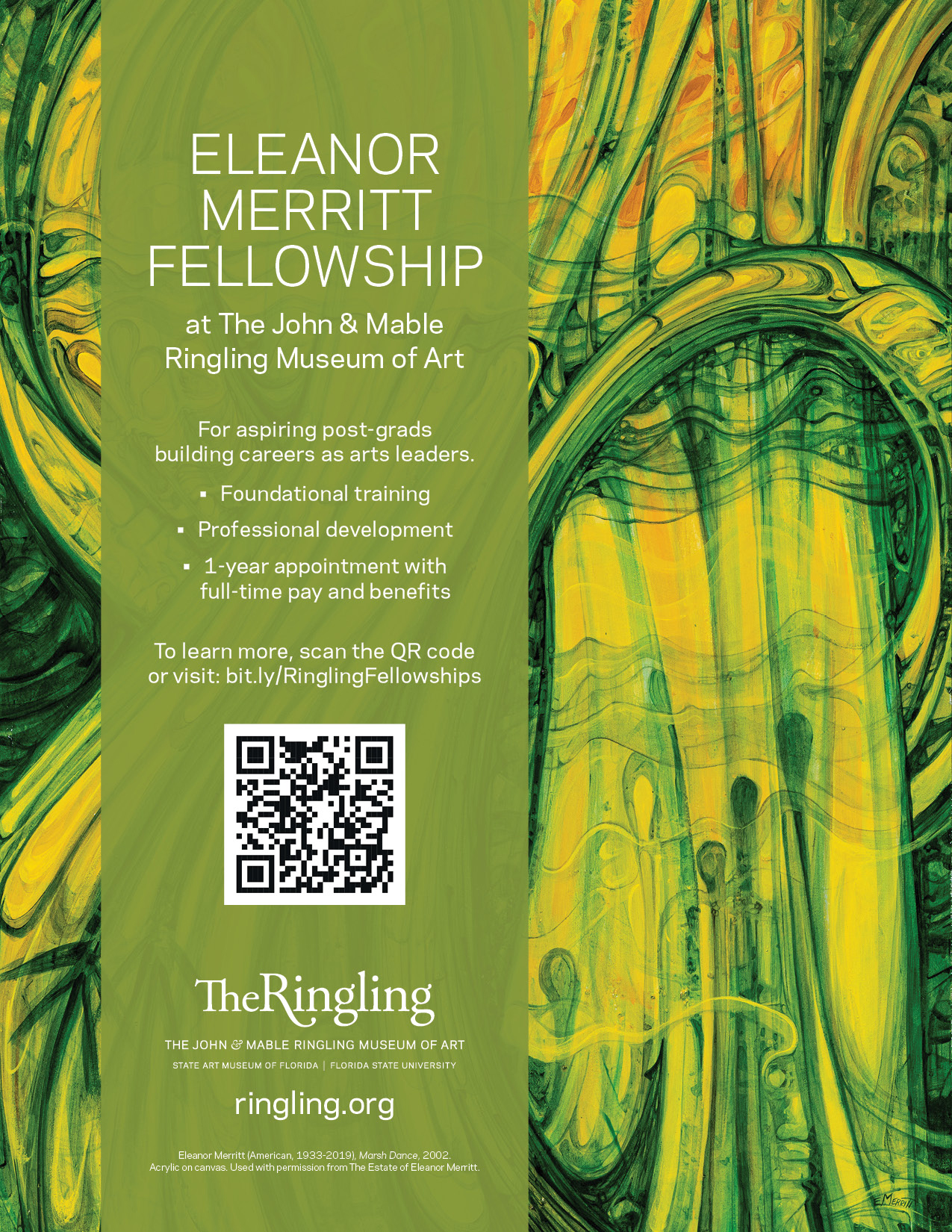
If you are unable to view this image, visit this site for details:
https://www.ringling.org/about-ringling/careers/internships-fellowships/
Job Openings at Mission San Luis in Tallahassee
Apply by March 1, 2026
Mission San Luis has a full-time and a part-time position available. Both are living history positions. The part-time would be perfect for a student that would like to get experience working at a museum. For information and to apply interested candidates can visit DOS – OPS MUSEUM EDUCATION PROGRAM S – 45945222 Job Details | State of Florida
Paid Summer Internships at the Saint Louis Art Museum
Apply by March 1, 2026
The Saint Louis Art Museum is pleased to offer four full-time, paid summer internships in 2026. These positions are open to current and recent undergraduate and graduate students. Applications are due by 11:59 pm CST on Sunday, March 1, 2026. Please follow this link to learn more about the program, specific internship areas, and application instructions: https://www.slam.org/careers-opportunities/internships/.
Newberry Library Summer Institute in Italian Paleography
Apply by March 15, 2026
|
|
|
|
CFP: SUNY New Paltz Undergraduate Art HIstory Symposium
Abstracts due January 31, 2026
CFP: UCSD Conference April 2026
Abstracts due January 31, 2026
Call for Papers and Artworks:
Outer Limits
The liminal expands across a spatio-temporal divide, limning demarcations between inside and outside, now and then, here and there, and us and them. Reaching for it, we might bump up against, and sometime erode, boundaries between the known and the unfamiliar. Yet, working through liminality engages not only with phenomenological experience but with processes and enactments. What might be necessary indeterminacies challenge ‘normative’ understandings or standard passages. Its affectual eventuations align with the anxieties of our current moment: an inexorable state of wait, being caught in-between.
We are all a little on edge these days, and though we may feel trapped, reflecting on liminal conditions might imagine queer and other non-standard or resistant wayfinding in the project of conceptualizing future-bound transformation or roundabout, even unstable, ways of unsettling the false consciousness of the status quo. If edges delineate barriers, such limits can also be productive and goad us into thinking, seeing, and pushing beyond. Maybe Mean Girls (2004) had it right: suggesting a radical rethinking of liminality by announcing that “the limit does not exist.” Or, to reframe, what are the stakes of questioning the very nature of being limited? As Luce Irigaray suggested in This Sex Which is Not One: “Leave definitiveness to the undecided; we don’t need it.”
For the inaugural Symposium and Exhibition presented through UCSD’s Art and Media History, Theory and Criticism department, we invite contributions that expand between fields and disciplines to consider liminality experientially, methodologically, and/or critically, and which present as zones of both vulnerability and possibility. What might arise when we center or trouble the interstitial in artistic practice? How does attention to instability, the unstable, or the marginal, open new relationalities across art and critical reflection, but also archives and institutions? What are the methodological and aesthetic stakes of working in and on the liminal, between disciplines, genres, or epistemologies? And what are the ontological risks and affordances of liminal discourse?
Though this conference seeks to push the boundaries, or challenge the limits, of the academic conference itself we offer these areas of thought as a beginning point to extend from:
● Edging, and its potentiality:
Satisfaction and fulfillment, delay and deferrals, or just being on the verge…
● Limbo, or lying in wait:
Caught in suspension, uncertainty, and anti-progress
● Straddling Margins, and trans identifications:
Border crossings, being between, refusing to fit
● Bottoming, and the downward turn:
Bottom-up formations of power, bottoming out, or just being down
● Passing, or its inverse of the neither/nor:
Asexual erotics, reveal and conceal strategies, or countering binaries
● Capacitations, or reaching the limit:
Blocks, barriers, moving through, and finalities
● Beyond Bounds, and its afterlives:
Thresholds, holes, and delimiting
Submissions
This event is organized by graduate students in UCSD’s PhD Program in Art and Media History, Theory and Criticism, the PhD Program in Art Practice, and the MFA Program. Through such interdisciplinary exchange we seek to provide space for those just breaking through, and we happily welcome emergent scholars, practices, and practitioners (alongside more established thinkers and makers) to share original research and creative work in this experimental format.
For presenters: We invite abstracts that think with and beyond these areas of interest (approximately 300 words), and also welcome experimental lectures and nontraditional presentations, to be submitted alongside a condensed CV (maximum 5-page PDF).
For artists: We welcome submissions of artworks in any medium for a group show and screeningaccompanied by a project description (approximately 300 words) and 3-5 images of the work (as .jpgs), to be submitted similarly alongside a condensed CV (maximum 5-page PDF).
We finally ask that all applicants include five keywords that situate the work submitted.
Please send all materials to visartssymposiumucsd@gmail.com by January 31, 2026. Accepted participants will be notified by February 10, 2026.
Don’t hesitate to contact us if you have any questions about this symposium or the submission process.
Free Webinar Series on Indigenous Collections Stewardship
FEBURARY 3, MARCH 3, APRIL 7, MAY 5
Rethinking Collections Stewardship
In partnership with the Indian Arts Research Center (IARC) at the School for Advanced Research and Gilcrease Museum, the Indigenous Collections Care (ICC) Speaker Series explores new frameworks for museum collections stewardship centered on Indigenous knowledge and values. Leading up to the anticipated release of the Indigenous Collections Care Guide, this series will highlight key components and themes within the upcoming Guide.
Through four panels—Intellectual Care of Collections, Physical Care of Collections, Relationship Building and Consultation, and Use and Access of Collections—panelists will engage in moderated conversations and roundtable discussions on culturally appropriate care practices. Each session highlights practical strategies, case studies, and collaborative approaches for reshaping institutional protocols around consultation, documentation, conservation, and access. Join us to learn from experts leading this vital work and to consider how your own institution can incorporate Indigenous care considerations into its collections stewardship practices.
Intellectual Care of Collections
February 3, 2026
2:00 – 3:30pm Central
Panelists:
Kara Vetter, Museum of Us
Evan Mathis, Museum of the Cherokee People
Meghan Dorey, Myaamia Heritage Museum and Archive
Physical Care of Collections
March 3, 2026
2:00 – 3:30pm Central
Panelists:
Dyan Youpee, Fort Peck Assiniboine and Sioux Tribes
Rebecca Rupe, Match-E-Be-Nash-She-Wish Band of Pottawatomi Indians
Amy Covell-Murthy, Carnegie Museum of Natural History
Relationship Building and Consultation
April 7, 2026
2:00 – 3:30pm Central
Panelists:
Laura Elliff Cruz, School for Advanced Research
Chance Ward, History Colorado
Marti Only A Chief, Pawnee Nation
Use and Access of Collections
May 5, 2026
2:00 – 3:30pm Central
Panelists:
Amanda Lancaster, Alutiiq Museum
Sarah O’Donnell, The Osage Nation
Ed Jolie, Arizona State Museum
RaeLynn Butler, The Muscogee (Creek) Nation
CFP: Twenty-first Annual Yale University American Art Graduate Symposium, April 2026
Abstracts due January 31, 2026
Call for Papers: The Twenty-first Annual Yale University American Art Graduate Symposium
Theme: Local
Date: April 11, 2026
Keynote Speaker: Dr. Caitlin Beach, Associate Professor of Art History, CUNY Graduate Center
What is at stake in identifying artists, subjects, materials, and economies as local? The term commonly circumscribes a particular space while evoking feelings of inclusion. To be “a local” is to belong to a place or a people, to have insider knowledge, to see oneself as part of a community, to be and feel at home. From quilts made by generations of Black women in Gee’s Bend to the centuries-long production of lienzos by Ñuu Dzaui, Nahua, and other Indigenous artists, objects play outsized roles in shaping and defining the local. Embracing the local may also function as a subversive move. Establishing a local artistic identity can oppose hegemonic national narratives, a gesture in line with what Arjun Appadurai has termed “the production of locality.” Maroon communities in the Caribbean, for instance, blended West African traditions with Taino knowledge and indigenous materials to assert their own definitions of place within imperial landscapes.
Across time, place, and media, artists and viewers alike have imagined and reimagined the local, stretching and compressing its contours to define who falls within its bounds. The term’s elasticity continues to provide fertile ground for new interpretations within art history and beyond. How does the local open onto discourses of repatriation and conservation, or histories of migration, diaspora, and Indigeneity? How do we navigate the term alongside related concepts like intimacy, insularity, and domesticity? How might locality interface with decoloniality?
Featuring Dr. Caitlin Beach as our keynote speaker, the Twenty-first Annual Yale University American Art Graduate Symposium asks what centering the local affords art historical inquiry. We welcome submissions exploring art, architecture, performance, and visual and material culture across the Americas, including the Caribbean, North, Central, and South America. Possible topics include, but are not limited to:
● Community-based artistic practices, collectivized artistic labor, and local artistic identity
● Local materialities and histories of industry
● Indigenous understandings of space, the local, and (home)lands
● Site specificity and placemaking
● Local audiences and reception
● The local in relation to provincialism, urbanism, and cosmopolitanism
● Local ecologies and economies; agrarianism and rural uplift
● Tourism and the commodified local
● The local and the nation state, narratives of locality and universality
You are invited to submit an abstract of no more than 350 words and a CV to americanist.symposium@gmail.com by January 31, 2026. Accepted participants will be notified in mid-February. “Local” will take the form of a day-long, in-person symposium, with food and hotel accommodations provided for all speakers.
William L. Clements Library Fellowships at the University of Michigan
Apply by Jan. 15, 2026
The William L. Clements Library at the University of Michigan welcomes applications for 2026-2027 research fellowships. The Clements’ holdings—books, manuscripts, pamphlets, maps, prints and views, newspapers, photographs, ephemera—are among the best in the world on almost any aspect of the American experience from 1492 through 1900, and support a diverse array of research projects.
Other strengths of the collections include: The Atlantic and Caribbean world, graphics and printed material, military history, gender and ethnicity, religion, the American Revolution, Native American history, slavery and antislavery, cartography, the Civil War, reform movements, travel and exploration, and others.
The Clements offers long–term (two to four months), short term (one month), and week-long fellowships, as well as a digital fellowship with no residency requirement. Applications are due by January 15, 2026 for research to be undertaken between June 1, 2026 and May 31, 2027. *Note that only one letter of recommendation is required for this cycle’s applicants.
Please visit our website at https://clements.umich.edu/research/fellowships/ or email clements-fellowships@umich.edu for more information.
Contact Email:
URL:
Paid Summer Internships at Ringling Museum of Art
Apply by Feb 1, 2026
-
Archives Centennial Intern
-
Circus Collections Intern
-
Education Youth and Families Intern
-
Technical Theater Intern
Washington DC Transit Authority Seeks ull-Time Public Arts Manager
Apply Now!
The Washington Metropolitan Area Transit Authority (WMATA) is seeking a strategic and creative public art professional with a passion for connecting projects to broader organizational goals, customer experience, and measurable impact. This role is responsible for shaping how public art contributes to increased ridership, an enhanced customer experience, and greater awareness of community initiatives across the Metro rail and bus network. We are seeking an experienced Arts Program Manager with a proven track record of delivering public art and cultural programming within a large, complex organization, while ensuring compliance with safety, accessibility, and operational standards. The ideal candidate demonstrates the ability to align organizational strategy, project management, artist partnerships, and community engagement to deliver impactful, accessible, and compliant arts programming that strengthens public connection to transit.
Minimum Qualifications
Education
- Bachelor’s degree in Arts Administration, Fine Arts, Art History, Museum Studies, Urban Planning, or a related field.
Experience
- Seven (7) years of progressively responsible experience managing public art programs, cultural projects, or similar initiatives preferably in transit, civic, or institutional settings.
Preferred
- Advanced degree in Arts Administration, Fine Arts, Art History, Museum Studies, Urban Planning, or a related field preferred.
Job Summary
The Arts Program Manager leads the development, implementation, and management of WMATA’s Arts in Transit program, increasing ridership and enhancing the rider experience through thoughtfully integrated public and community art. This role oversees all aspects of public and community art integration throughout Metro stations, facilities, and events, including permanent commissions, temporary exhibitions, performing arts programming, and other community engagement initiatives. The Arts Program Manager works collaboratively across departments to increase awareness and ridership, ensure artistic excellence, all while improving operational requirements, safety standards, budget parameters, community engagement, and programmatic evaluation and impact.
Learn more on LinkedIn: https://www.linkedin.com/jobs/view/4351390757/
Appalachian State University Seeks Lecturer in Art History
Apply Now!
Appalachian State University in Boone, NC, seeks a PhD graduate (by the time of hiring) for a non-tenure track position as Lecturer in Art History. This is a 9-month, 3/4-time position. The lecturer will teach six courses per year, including art history surveys and upper-level courses in area(s) of specialization.
Teaching will occur in person at the Boone campus. Requirements:
- Demonstrated specialization in any period of global art history/visual culture.
- College-level teaching experience at the TA level or beyond.
Complete details and application here: https://appstate.peopleadmin.com/postings/52551
Baseball Hall of Fame Summer Internship Opportunities – Stipends and Course Credit
Apply by January 31, 2026
Ekphrasis: An Art History Graduate Journal, Tufts University
Submissions due January 20, 2026
Graduate Student Call for Papers/Proposals: Ekphrasis: An Art History Graduate Journal
Department of the History of Art and Architecture at Tufts University Inaugural issue to be published Spring 2026
All submissions are due by January 20, 2026 to tufts.ekphrasis.journal@gmail.com. Please include the relevant section title (Academic Essay, Book Review, or Exhibition Highlight) in the subject line of your email submission. E
kphrasis is an online scholarly journal produced by the graduate students of the Department of the History of Art and Architecture at Tufts University. Published annually in partnership with Tisch Library, the journal will provide a platform for art historical exploration and analysis to fulfill its essential objective of foregrounding critical, diverse, and innovative perspectives both within and beyond Tufts University.
Academic Essays For the inaugural issue of Ekphrasis, we welcome academic essay submissions from current graduate students or those who have recently (within the past three years) completed a graduate program at the master’s or PhD level in or related to the field of art history. Academic essays should be approximately 2,500-3,000 words (excluding footnotes) and written on any topic broadly pertaining to art history. Essays should be previously unpublished and submitted in full, with correctly formatted Chicago-style citations.
Images should be integrated into the text (rather than as a list of figures at the end), and authors whose submissions are selected for publication will be responsible for securing reproduction permissions from the copyright owner of any included images. Selected authors will work with the Ekphrasis Image and Copyright Editor to ensure that proper permissions are obtained.
While future issues may be centered around a designated theme, the call for papers for the Spring 2026 issue does not have a thematic guideline. As such, we welcome academic essays on any topics relevant to the field of art history, across all time periods and geographical contexts.
Selected submissions will be edited by the Ekphrasis faculty-supplemented editorial board. Interested graduate students should submit, along with the academic essay in full, a CV and short professional and academic biography compiled into a single document to tufts.ekphrasis.journal@gmail.com.
If you have any questions regarding academic essays or the journal at large, please contact kristen.lauritzen@tufts.edu or kate.haggarty@tufts.edu.
Book Reviews Ekphrasis welcomes book review submissions from current graduate students or those who have recently (within the past three years) completed a graduate program at the master’s or PhD level in or related to the field of art history. Book reviews should be between 500-1,000 words and focus on scholarly publications regarding art historical topics published within the last three years, employing a descriptive as well as analytical approach to the text at hand.
We request that proposals be no more than 100 words and contain publication information for the proposed book (author, editor, book title, publishing information, and ISBN). Please also include a CV and a short professional and academic biography compiled into a single document and submit all items to tufts.ekphrasis.journal@gmail.com.
If you have any questions regarding book reviews, please contact Maria Wuerker at maria.wuerker@tufts.edu.
Exhibition Highlights Ekphrasis invites current graduate students or those who have recently (within the past three years) completed a graduate program at the master’s or PhD level in or related to the field of art history to submit short pieces (no longer than 500 words) that highlight art exhibitions taking place throughout the greater New England area. These submissions are not intended as full reviews, but as concise features that capture the essence of an exhibition, offering readers a broad view of the region’s art scene. Each highlight should provide an overview of the relevant artist or artists and explore the major themes presented in the exhibition.
Preference will be given to exhibitions that remain on view during the journal’s publication period (April-June 2026). Interested graduate students are asked to submit a 100-word proposal to tufts.ekphrasis.journal@gmail.com, describing the exhibition they wish to feature, along with a CV and a short professional and academic biography, compiled into a single document.
If you have any questions regarding exhibition highlights, please contact Kendall Murphy at kendall.murphy@tufts.edu.
CFP: Twenty-first Annual Yale University American Art Graduate Symposium, April 11, 2026
Proposals due January 31, 2026
Call for Papers: The Twenty-first Annual Yale University American Art Graduate Symposium
Theme: Local
Date: April 11, 2026
Keynote Speaker: Dr. Caitlin Beach, Associate Professor of Art History, CUNY Graduate Center
What is at stake in identifying artists, subjects, materials, and economies as local? The term commonly circumscribes a particular space while evoking feelings of inclusion. To be “a local” is to belong to a place or a people, to have insider knowledge, to see oneself as part of a community, to be and feel at home. From quilts made by generations of Black women in Gee’s Bend to the centuries-long production of lienzos by Ñuu Dzaui, Nahua, and other Indigenous artists, objects play outsized roles in shaping and defining the local. Embracing the local may also function as a subversive move. Establishing a local artistic identity can oppose hegemonic national narratives, a gesture in line with what Arjun Appadurai has termed “the production of locality.” Maroon communities in the Caribbean, for instance, blended West African traditions with Taino knowledge and indigenous materials to assert their own definitions of place within imperial landscapes.
Across time, place, and media, artists and viewers alike have imagined and reimagined the local, stretching and compressing its contours to define who falls within its bounds. The term’s elasticity continues to provide fertile ground for new interpretations within art history and beyond. How does the local open onto discourses of repatriation and conservation, or histories of migration, diaspora, and Indigeneity? How do we navigate the term alongside related concepts like intimacy, insularity, and domesticity? How might locality interface with decoloniality?
Featuring Dr. Caitlin Beach as our keynote speaker, the Twenty-first Annual Yale University American Art Graduate Symposium asks what centering the local affords art historical inquiry. We welcome submissions exploring art, architecture, performance, and visual and material culture across the Americas, including the Caribbean, North, Central, and South America. Possible topics include, but are not limited to:
-
Community-based artistic practices, collectivized artistic labor, and local artistic identity
-
Local materialities and histories of industry
-
Indigenous understandings of space, the local, and (home)lands
-
Site specificity and placemaking
-
Local audiences and reception
-
The local in relation to provincialism, urbanism, and cosmopolitanism
-
Local ecologies and economies; agrarianism and rural uplift
-
Tourism and the commodified local
-
The local and the nation state, narratives of locality and universality
You are invited to submit an abstract of no more than 350 words and a CV to americanist.symposium@gmail.com by January 31, 2026. Accepted participants will be notified in mid-February. “Local” will take the form of a day-long, in-person symposium, with food and hotel accommodations provided for all speakers.
CFP: 42nd ANNUAL FSU ART HISTORY GRADUATE STUDENT SYMPOSIUM
Abstract submission deadline December 1, 2025
The Florida State University Art History faculty and graduate students invite current PhD and MA students to submit abstracts for papers to be presented at the 42nd Annual Art History Graduate Student Symposium. The symposium will take place March 6–7, 2026, on our main campus in Tallahassee, FL.
The Symposium keynote speaker this year will be Claudia Brittenham, Professor of Art History and Race, Diaspora, and Indigeneity and Director of the Center for Latin American Studies at the University of Chicago. Dr. Brittenham’s research focuses on the art of ancient Mesoamerica, with particular attention to the ways that the materiality of art and the politics of style contribute to our understanding of the ontology of images.
The symposium committee welcomes papers that represent an advanced stage of original research from all areas of study within art and architectural history and visual and material culture. Paper sessions will take place Friday and Saturday with critical discussions following each speaker. Papers presented will be considered for inclusion in Athanor, our internationally distributed, peer-reviewed journal.
Please include the following in your application:
• Abstract (maximum 500 words), including a paper title
• Current CV
We encourage applicants to ask a faculty advisor to review the paper before submission.
The deadline for submission is December 1, 2025.
Send abstracts and CV to: FSUSymposium@gmail.com
For updates, visit arthistory.fsu.edu/sympo
Native American and Indigenous Studies (NAIS) Research, Travel, and Creative Works Grant
FSU’s Native American and Indigenous Studies Center strives to support student research and artistic activity that focuses on and engages with Native American and Indigenous communities across the globe. Towards that end, this grant fund provides students with reimbursable funding to assist in research, travel, and creative works that are focused on creating and/or developing knowledge with Native and Indigenous partners and/or to support travel related to disseminating knowledge at conferences, meetings, and/or workshops. Creative works and activities associated with Indigenous nations are also encouraged.
COMPLETE DETAILS & APPLICATION REQUIREMENTS
CFP: The Archival Art Historian, an ICMA-Sponsored Panel at CAA, February 2026
Submission deadline August 29, 2025
This panel is sponsored by the International Center of Medieval Art (ICMA). If your paper is accepted and you are not already a member of the ICMA, you will be required to join by February 2026. Some funding to assist with the cost of attending the conference may be available to speakers through the ICMA Kress Travel Grant Fund. Contributing panellists will have the opportunity to submit their paper for publication in a special issue of the open-access journal Different Visions, titled ‘Points of Friction’, and co-edited by Dr Millie Horton-Insch and Dr Lauren Rozenberg.